Meomy

What are some active recall examples? Answer a flashcard before flipping it, rebuild a diagram from memory, or solve a fresh problem with the worked solution covered. Each example follows the same pattern: attempt an answer, compare it with a reliable source and try again later. The examples below include sample prompts, plausible incomplete answers and a way to repair each mistake, so you can turn your own lecture material into questions instead of rereading it from beginning to end.
How active recall works
Active recall, also called retrieval practice, asks you to produce something from memory before you consult the source. The result might be a definition, a sequence, an explanation or the first line of a calculation. What matters is being able to compare your attempt with what the task actually requires. Cornell Learning Strategies Center
Start by learning the material well enough to make a first attempt. Then close or cover it. If you spend the whole time reading the answer, it is difficult to tell what you can produce independently. The University of Waterloo describes testing yourself with practice questions, flashcards and explanations as ways to put this distinction into practice. University of Waterloo study tips
Use a trustworthy reference for feedback. That can be your course notes, an instructor's answer key or a textbook explanation. Record the difference between your answer and the source in one short line. Give that line a purpose by turning it into a prompt for later.
The following situations are invented practice examples. Their point is to show how an ordinary review task can become an observable attempt, with a check you can perform yourself.
Example 1: Answer a flashcard before turning it over
Suppose your class notes define a thesis statement as the central claim an essay develops. A card that says “Thesis statement” on the front may prompt a quick recognition response. A more specific question is “What job does a thesis statement do in an argumentative essay?”
Close the notes and answer aloud. An incomplete answer might be “It tells you the topic.” Compare it with your reference and notice what is missing: the distinction between naming a topic and stating a claim about it.
Make the repair concrete. “Public transit” is a topic. “The city should run buses later on weekdays” is a position someone can defend. A useful second card asks you to explain which of those lines makes a claim and why.
If the answer keeps slipping, avoid adding several unrelated definitions to the back of the card. Split the prompt into a definition card and an application card. For a look at different digital workflows, see the iPhone flashcard app comparison.
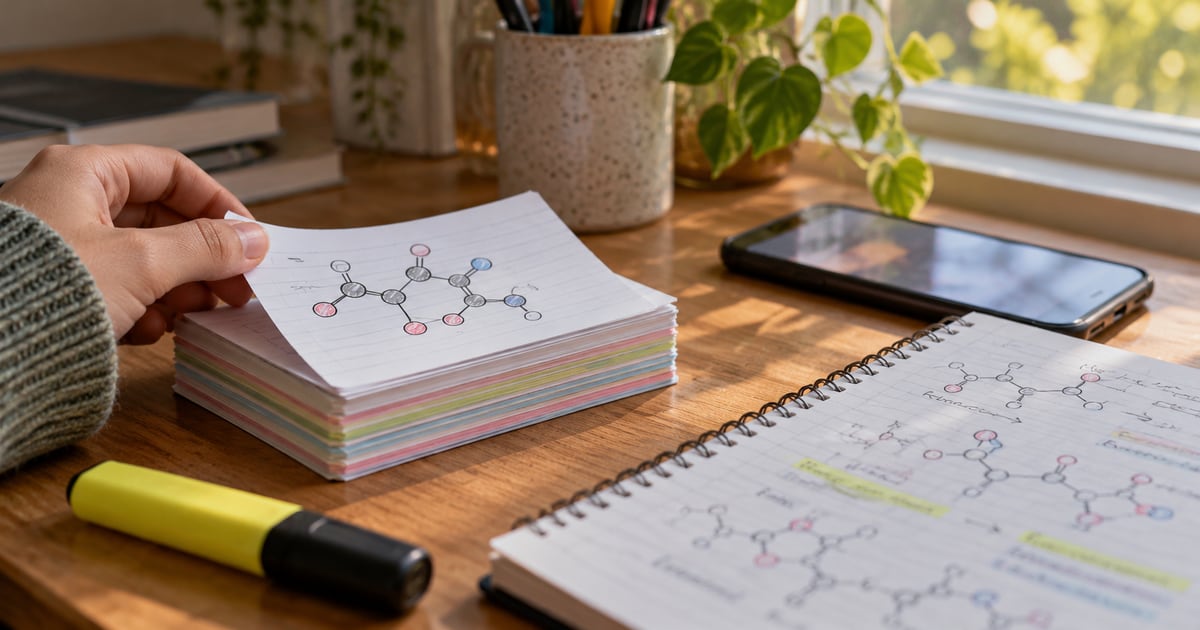
Example 2: Rebuild a diagram with the labels covered
Suppose your course handout shows a simplified water cycle with evaporation, condensation, precipitation and collection. Read the figure once and notice what each arrow represents. Then cover it and draw a basic version using boxes and arrows.
An incomplete attempt might put condensation before evaporation in the segment you are describing. Reopen the figure and trace the route from surface water to water vapour and then to cloud droplets. Circle the arrow you reversed. You can check the underlying cycle against the US Geological Survey's diagram. USGS water cycle overview
Try again on a blank page, starting from a different point in the cycle. That tests whether you can explain the relationship rather than reproduce the same layout. Leave out extra branches if they are beyond the scope of the prompt.
A plain sketch is enough. Decide whether you are checking the names, the directions of the arrows or the explanation for each change. Mark the attempt against that objective, even if your drawing looks nothing like the textbook illustration.
Example 3: Explain a difference without borrowing the wording
Suppose you need to distinguish a sample from a population in an introductory statistics course. Write a prompt that gives you a scenario: “A college surveys 100 of its enrolled students to learn about the travel habits of everyone enrolled. What is the sample and what is the population?”
An incomplete answer might be “The population is the people surveyed.” Check the scope of the question. The population is the full group the investigation concerns, while the sample is the surveyed subset. Try the explanation again in your own words, using the college example. OpenStax statistics definitions
Now change the question. If the college wants to learn only about first-year students, the population changes. The purpose of the new example is to see whether you can identify the intended group when the wording shifts.
An explanation is easier to check if you state the distinction and show it in the scenario. If your answer is fluent but cannot explain why the two groups differ, revisit the definition and produce a simpler answer before trying another case.
Example 4: Solve a new problem with the worked solution closed
After reviewing a worked example, hide the solution and choose a related problem with different numbers. For instance, if your notes showed how to find 15% of 80, attempt 15% of 60. Write the setup before calculating.
An incorrect attempt might compute 60 ÷ 0.15. Compare that operation with your worked example. You already know the whole amount and the rate, so the part is 0.15 × 60, or 9. The wrong operation would answer a different question about finding a whole from a known part.
Use that distinction to make a follow-up prompt. “If 9 is 15% of a number, find the number” now calls for division. Work both versions from scratch and say what is given each time. OpenStax percent applications
Record the error in plain language, such as “I divided when the whole was already given.” Later, pick a problem where the unknown is in a different position. The goal is to retrieve the decision as well as the arithmetic.
Example 5: Turn a page of notes into a mini quiz
Pick one section of a lecture and write three prompts while the material is available. Ask for one definition, one relationship and one application. Close the notes before you answer. This uses the same principle as covering the notes column and reciting from cues in the Cornell note-taking system. Cornell note-taking guide
For an invented library-policy example, your notes say books can be renewed once unless another reader has reserved them. Your questions might be “How many renewals are allowed?”, “What blocks a renewal?” and “Can I renew a reserved book that I have never renewed before?”
A partial attempt might remember the one-renewal limit and miss the reservation exception. The third question exposes the omission because it forces you to use both details at once. Check the source and rewrite the answer with the exception visible.
If you prefer starting with a blank page, the blurting method guide shows a related format. A mini quiz is handy when you want to check particular details, while a blank-page attempt lets you see what you can reconstruct from a broader topic.
How to do your own
Choose a small section and ask what you will need to do with it. If your exam requires identifying structures, practise with an unlabeled diagram. If it requires explaining a decision, create a short scenario. If it requires solving problems, make sure your practice asks you to choose the operation as well as carry it out.
Use this sequence for a study session:
- Write a prompt with a clear outcome.
- Hide the answer and produce your own response.
- Check the source and name the most useful correction.
- Try a fresh prompt now or return to the same skill in a later session.
For a record you can use again, write “prompt,” “my attempt” and “what I missed” in separate columns. Keep corrections specific. “Forgot the exception” tells you what to look for. “Bad at chapter three” gives you little to work with.
When you prepare for a closed-book exam, make at least some attempts with the same resources that will be allowed on the day. If your class provides practice tests, use their marking information to decide which topics to revisit. Cornell practice exam guidance
How Meomy AI can help
Meomy AI can turn PDFs, lecture recordings and notes into flashcards and quizzes. Its supplied feature description also includes teach-back sessions with feedback, with that feature requiring Meomy Pro. These formats can support practice when your material is already on your phone.
Before answering, hide the source and give yourself time to make an attempt. Check generated questions and answers against your course material, particularly if a definition or exception affects your grade. Keep the correction in your own words and use it to choose the next question. Follow your institution's rules on uploading course material and using AI.
Conclusion
Begin with one prompt from the material you are already studying. Try the answer before opening the source, then compare what you produced with what the question required. Change the prompt when you want to test whether you can apply the idea in a new situation. A short note about the exact gap gives you a concrete place to start the next session.
Frequently asked questions
What is a simple example of active recall?
Read a flashcard prompt and say or write your answer before turning it over. Compare the answer you produced with the reference. If you missed part of it, write a follow-up prompt that asks specifically about that detail.
Is reading notes active recall?
Reading notes gives you material to learn and check. To add active recall, cover the relevant section and try to explain it from memory first. Reopen your notes afterward to see whether you remembered the key ideas and relationships.
Can active recall work for maths?
Yes. Cover a worked solution and try a similar question with different numbers or a different unknown. Write the operation you chose and explain why. Compare your solution with the reference and record any error in the setup or calculation.
What should I do when I cannot remember an answer?
Make a short attempt and identify where you got stuck. Consult the reference and correct that part. Then close it and try a similar prompt. Keep a note of the gap so you can revisit it in a later session.